
The Hidden Cost of Jargon
How to turn dense jargon, specialized research, and technical expertise into clear, high-converting content.
If you lead a technical team, manage a healthcare organization, or run a specialized B2B brand, you already know the frustration: your experts built something incredible, but when it’s time to explain it to buyers, investors, or patients, the message falls flat.
It’s not a product problem—it’s a translation problem.
When subject matter experts (SMEs) communicate, they naturally use shorthand, acronyms, and heavy technical language. To them, it’s precise. But to non-technical decision-makers, it sounds like static. And in modern business, content without strategy is just noise.
When prospective clients or stakeholders struggle to understand your message, they may not ask for clarification. Instead, they may turn to a competitor with a clearer value proposition.
This guide breaks down how to bridge the gap between deep technical expertise and everyday human clarity. Whether you’re refining your B2B SaaS messaging, explaining clinical data to patients, or securing grant funding for a complex nonprofit program, mastering technical copywriting is key to turning complex ideas into measurable business growth.
4 Key Industries Facing the "Jargon Trap"
While unclear messaging can affect any complex business, four sectors face particularly significant communication challenges when technical concepts fail to translate.
1. Healthcare, BioTech & Digital Health
The Reality: Clinicians, researchers, and biotech developers speak in clinical trial data, regulatory frameworks, and specialized medical terminology.
The Pain Point: Hospital administrators, enterprise buyers, and patients aren't reading for academic peer review—they want to understand outcomes, safety, and ease of care. When clinical jargon obscures the human benefit, adoption stalls and sales cycles drag on.
2. B2B SaaS, Software & Tech Infrastructure
The Reality: Technical founders and software engineers build incredible backend architecture, API capabilities, and feature-rich platforms.
The Pain Point: Non-technical buyers (like CMOs, CFOs, or Operations Directors) rarely care about the raw code. They care about ROI, efficiency, scalability, and security. If your website or whitepapers focus purely on specs rather than business outcomes, prospective buyers disengage.
3. Nonprofits, Foundations & Public Policy
The Reality: Program directors and policy researchers write comprehensive impact reports, whitepapers, and grant proposals grounded in dense academic data.
The Pain Point: Donors, community leaders, and board members need compelling, human-centered narratives to approve funding or buy into a campaign. Heavy policy jargon buries the emotional spark that drives action.
4. Financial Services, InsurTech & Compliance
The Reality: Subject matter experts rely on heavy legal, regulatory, or complex risk-modeling language.
The Pain Point: Prospective clients and enterprise partners get intimidated by dense disclaimers and abstract financial structures, making it difficult to build trust quickly.
Technical Writing vs. Technical Copywriting
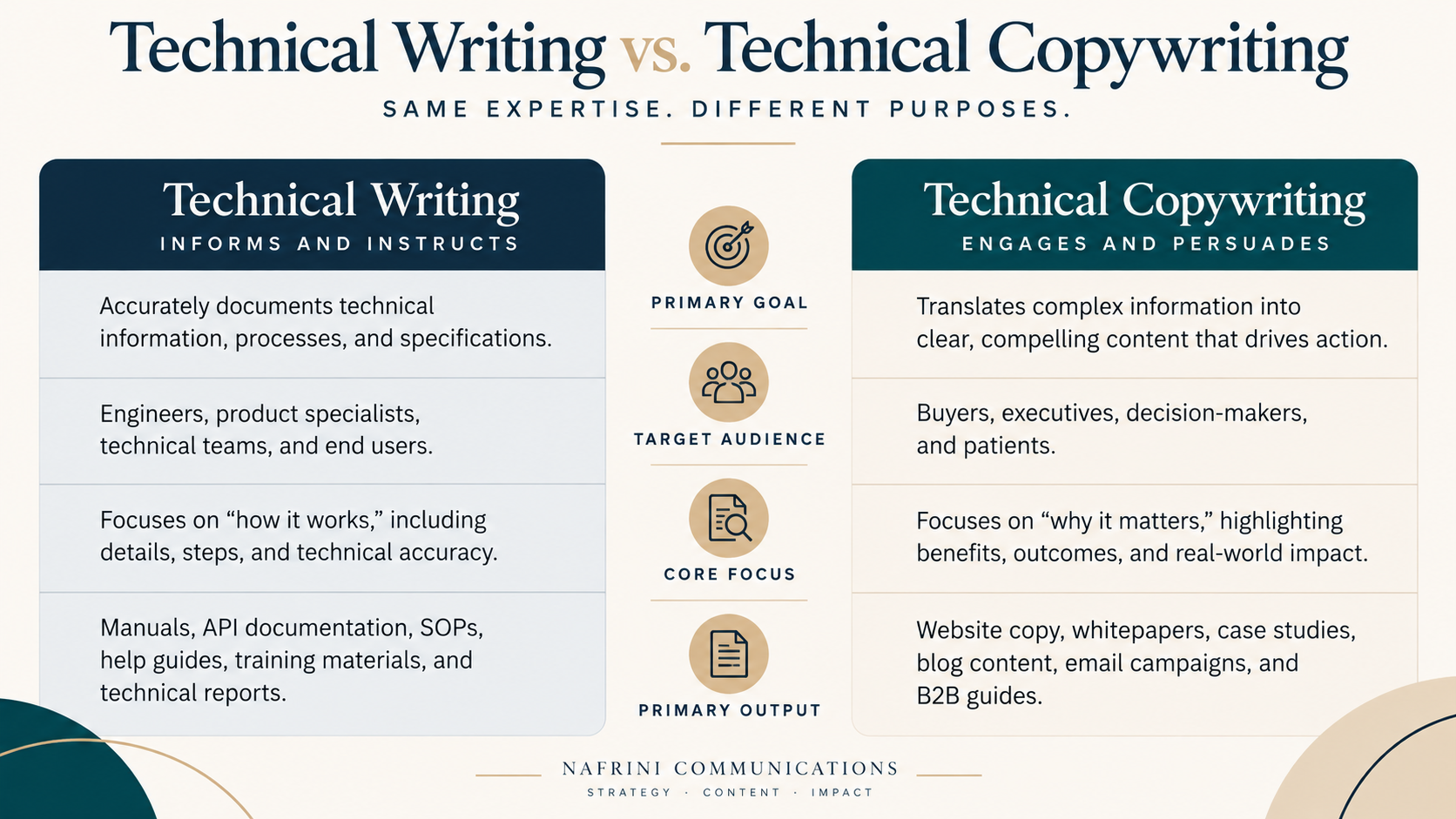
One of the most common points of confusion for hiring managers and marketing leads is understanding the difference between technical writing and technical copywriting. While both require a deep understanding of complex topics, their goals, audiences, and outcomes differ fundamentally.
Technical Writing is designed to inform and document. It creates user manuals, API documentation, compliance guides, and internal standard operating procedures (SOPs). Its audience often includes engineers, developers, technical specialists, and end users who need accurate, structured information about how a product, system, or process works.
Technical Copywriting is designed to engage, persuade, and convert. It takes dense technical information, scientific research, or product capabilities and translates them into strategic messaging. Its primary audience is decision-makers, executives, buyers, or patients who care less about backend mechanics and more about why it matters.
To drive growth, your business doesn't need to replace technical documentation—you need a strategic bridge that translates expert knowledge into high-converting story and messaging.
The 3-Step Content Translation Framework
Translating dense technical concepts into clear, engaging content isn't about dumbing down the material—it’s about illuminating the value. When working with subject matter experts (SMEs), this practical three-step framework can help uncover core insights and develop clearer, more persuasive B2B messaging.
Step 1: The SME Extraction Interview (Asking "So What?")
Technical experts know their fields intimately, but they often struggle to identify what matters to a non-technical buyer. During interviews, ask targeted probing questions that push past technical specs:
"What specific problem does this feature solve for the end user?"
"If a decision-maker implements this today, what measurable outcome will they see in 90 days?"
"What is the financial, operational, or emotional cost of NOT fixing this problem?"
By repeatedly asking "So what?", you strip away jargon and uncover the core business impact.
Step 2: Jargon Translation & Analogy Mapping
Once you have the technical facts, identify the terms that create cognitive friction for non-experts. Replace dense terminology with accessible language or familiar metaphors:
Instead of: "Utilizing asynchronous API endpoints to optimize database query latencies."
Translate to: “Speeding up page load times so your team spends less time waiting on data.”
The goal is to preserve technical accuracy while making the information accessible, relevant, and immediately meaningful to non-technical stakeholders.
Step 3: Outcome-First Narrative Structuring
Busy executives and recruiters scan content quickly. If you lead with 500 words of background methodology, they will bounce off the page. Always structure technical content with an outcome-first hierarchy:
The Hook: State the real-world problem and immediate benefit.
The Proof: Introduce the technical methodology or data as the supporting evidence (not the main star).
The Action: Guide the reader to a clear, logical next step (booking a demo, downloading a report, or reaching out).
Technical Copywriting in Action: A Before-and-After Example
To see technical copywriting in action, consider this illustrative example of how a dense, feature-focused healthcare statement can be transformed into a clearer, outcome-driven value proposition.
Before (Dense & Jargon-Heavy):
"Our proprietary digital healthcare platform utilizes machine learning algorithms and real-time FHIR-compliant API interoperability to optimize patient triage workflows, reducing administrative latency across multi-specialty clinical operations."
Why It Fails: Non-clinical decision-makers get bogged down in technical specs like FHIR-compliant API interoperability and abstract terms like administrative latency. The true benefit gets lost in technical static.
After (Clear, High-Converting Copy):
"Our healthcare platform connects your clinical systems in real time, helping staff triage patients faster, reduce administrative delays, and support more coordinated care."
Why It Works:
Instant Clarity: Focuses immediately on outcomes (faster triage, reduced delays, better patient care).
Accurate Yet Accessible: Keeps the core solution clear without sacrificing credibility.
Human-Centric: Speaks directly to the operational headache clinical leaders care about most.
Call to Action
With generative AI tools accessible at everyone's fingertips, creating generic content has never been easier. While AI can assist with research, interviews, and content development, it cannot independently replace the strategic judgment, contextual understanding, and human insight required to communicate complex ideas effectively.
AI can generate text, but human expertise remains essential to interpret subject-matter insights, understand audience needs, align messaging with business goals, and build authentic brand trust.
When high-stakes buyers, healthcare executives, or prospective partners read your content, they aren't looking for automated fluff—they are looking for authoritative clarity.
Turn Your Complex Ideas into Measurable Growth
Clear messaging isn't just a nice-to-have. It can help reduce friction in the buyer's journey, support stronger conversion rates, and reinforce brand authority. If your team is struggling to translate dense technical concepts, scientific data, or complex software features into compelling narrative content, you don't have to navigate it alone.
Nafrini Communications specializes in content strategy, technical message translation, and fractional lead support for B2B, healthcare, and nonprofit brands.
Your expertise deserves messaging that communicates its value.
Let's make sure your audience understands not just what you do, but why it matters.
I'd be glad to partner with you.